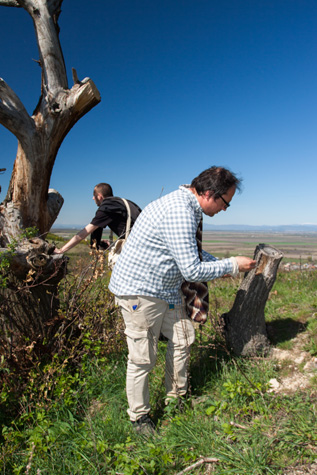
Understanding the distributional patterns of organisms is one of the fundamental questions of modern ecology. It is also essential for biodiversity conservation, forestry and agriculture. Therefore our studies commonly deal with the investigation of the communities of insects in woodland habitats on various different scales. A significant part of our studies is focused on the diverse group of saproxylic beetles, but also on butterflies, moths, bees and wasps or other groups. We are interested in how environmental factors like vertical and horizontal forest structure, altitude, latitude and management history influence the structure of insect communities. In this regard, we do not only analyze the species richness and composition of insect assemblages from differing habitats but also functional aspects like guild composition. Our studies not only indicate that insect communities clearly differ along the vertical and horizontal scale of woodland habitats, but also that these differences may vary depending on the kind of habitat. With our work we show that these habitats host rather distinct communities of insects, thereby contributing to global biodiversity.
Members involved
Lukáš Čížek, Pavel Šebek, Petr Kozel, Lucie Ambrožová, Michal Perlík, Claudio Sbaraglia, Veronika Grygarová, Gioele Moro
Related papers
The potential role of volatile organic compounds on the colonisation of deadwood by saproxylic beetles.Sbaraglia C. et al. 2026, Oecologia.
Taxonomic and methodological biases in saproxylic beetles: Body size, trophic group and detection probability.Franzén M. et al. 2026, Insect Conservation and Diversity.
Sun exposure as a main driver influencing the arriving communities of saproxylic beetles on deadwood.Sbaraglia C. et al. 2025, Ecological Entomology.
The Shape and Material of the Flight Interception Trap Matter for Beetle Sampling.Sbaraglia C. et al. 2025, Journal of Applied Entomology.
Effects of hybridization on chemical diversity and plant-insect herbivore interactions in Salix alba × fragilis.Renoult S.A. et al. 2025, Journal of Experimental Botany.
Effects of pronounced seasonal turnover and intraspecific variation in leaf traits on specialization of insect herbivores associated with six Salicaceae hosts.Mezzomo P. et al. 2025, Oecologia.
Plant and saproxylic beetle dynamics during succession in lowland temperate broadleaf forests reveal only short periods of increased diversity.Lanta V. et al. 2025, Biological Conservation.
Effects of individual traits vs. trait syndromes on assemblages of various herbivore guilds associated with central European Salix.Leong J.V. et al. 2024, Oecologia.
Contrasting levels of β-diversity and underlying phylogenetic trends indicate different paths to chemical diversity in highland and lowland willow species.Volf M. et al. 2023, Ecology Letters.
Leaf volatile and nonvolatile metabolites show different levels of specificity in response to herbivory.Mezzomo P. et al. 2023, Ecology and Evolution.
Alternative measures of trait–niche relationships: A test on dispersal traits in saproxylic beetles.Burner R.C. et al. 2023, Ecology and Evolution.
Changes in β-diversity of saproxylic beetles along environmental gradients in temperate forests depend on species relative abundances.Šebek P. et al. 2022, Journal of Biogeography.
Determinants of invasion by single versus multiple plant species in temperate lowland forests.Lanta V. et al. 2022, Biological Invasions.
Specialised chemistry affects insect abundance but not overall community similarity in three rare shrub willows: Salix myrtilloides, S. repens and S. rosmarinifolia.Kozel P. et al. 2022, European Journal of Entomology.
High-resolution 3D forest structure explains ecomorphological trait variation in assemblages of saproxylic beetles.Drag L. et al. 2022, Functional Ecology.
Functional structure of European forest beetle communities is enhanced by rare species.Burner R.C. et al. 2022, Biological Conservation.
Understanding the drivers of β-diversity improves conservation prioritization for Central European dung beetles.Ambrožová L. et al. 2022, Biological Conservation.
Contrasting responses of saproxylic beetles and plants to non-native tree invasion reveal feedback mechanisms between trophic levels.Lanta L. et al. 2021, Biological Conservation.
What does a threatened saproxylic beetle look like? Modelling extinction risk using a new morphological trait database.Hagge J. et al. 2021, Journal of Animal Ecology.
Butterfly and moth communities differ in their response to habitat structure in rainforests of Mount Cameroon.Delabye S. et al. 2021, Biotropica.
Traits mediate niches and co-occurrences of forest beetles in ways that differ among bioclimatic regions.Burner R.C. et al. 2021, Journal of Biogeography.
Choosy beetles: How host trees and southern boreal forest naturalness may determine dead wood beetle communities.Burner R.C. et al. 2021, Forest Ecology and Management.
Lasting decrease in functionality and richness: Effects of ivermectin use on dung beetle communities. Ambrožová L. et al. 2021, Agriculture, Ecosystems & Environment.
Saproxylic beetles in tropical and temperate forests – A standardized comparison of vertical stratification patterns.Weiss et al. 2019, Forest Ecology and Management.
Vertical stratification of scolytine beetles in temperate forests. Procházka J. et al. 2018, Insect Conservation and Diversity.
Open-grown trees as key habitats for arthropods in temperate woodlands: The diversity, composition, and conservation value of associated communities.Šebek et al. 2016, Forest Ecology and Management.
Fine-Scale Vertical Stratification and Guild Composition of Saproxylic Beetles in Lowland and Montane Forests: Similar Patterns despite Low Faunal Overlap.Weiss et al. 2016, PloS ONE.
The effects of edge-interior and understorey-canopy gradients on the distribution of saproxylic beetles in a temperate lowland forest.Vodka and Čížek 2013, Forest Ecology and Management.
Arthropod diversity in a tropical forest.Basset, Čížek et al. 2012, Science.
Saproxylic beetles in an isolated pollard willow stand and their association with Osmoderma barnabita (Coleoptera: Scarabaeidae).Šebek P. et al. 2012, Studia Forestalia Slovenica.
A test for assessment of saproxylic beetle biodiversity using subsets of “monitoring species”.Šebek P. et al. 2012, Ecological Indicators.
Host plant defences and voltinism in European butterflies.Čížek L. et al. 2006, Ecological Entomology.
Diet composition and body size in insect herbivores: Why do small species prefer young leaves?Čížek L. 2005, European Journal of Entomology.
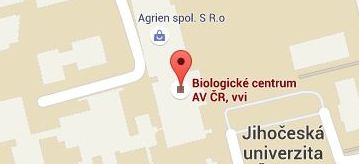
Biology Centre CAS Institute of Entomology Branišovská 31 370 05 České Budějovice Czech Republic