


Landscape ecology
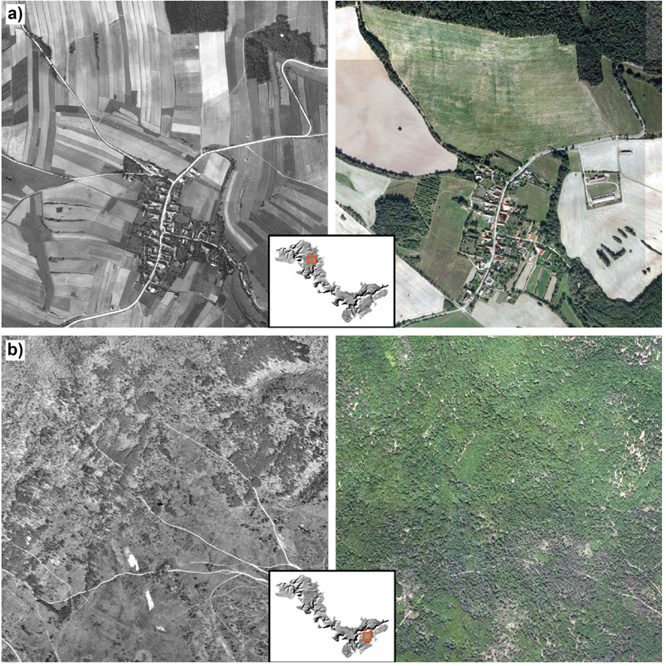
The European landscape was shaped throughout the centuries by a large scale of disturbances, either natural or human-induced, which played a key role in shaping the whole ecosystem and development of wildlife biota. A plethora of recent studies suggests that transition from extensive to intensive agriculture or forestry during the past two centuries had a negative impact on the whole communities of organisms. To further understand the more complex relationship between organisms and the environment, there is a necessity to merge subjects of ecology and geography. This field is called landscape ecology and its main essence is the exploration of spatial patterns related to wildlife organisms.
The main proportion of our research aims focuses on spatial analyses in the landscape, which results in the change of components in the landscape cover and related changes in the overall landscape composition. Our work presents a spatial composition of maps characterizing possible changes in the landscape and prediction analyses of abundance or probability occurrence of the specific organism in the context of land use and land cover changes. Additionally, these data can be linked to research from other fields of science.
Related maps:
Veteran trees and saproxylic insects in the floodplains of lower Morava and Dyje rivers
(Czech or English).
Pollarded willows in South Moravian region (Czech).
Members involved
Jan Miklín, Gwendoline Percel, Pavel Šebek
Related publications
- Sbaraglia C., Samraoui K.R., Massolo A., Sucháčková Bartoňová A., Konvička M., Faltýnek Fric Z. (2022) Back to the future: Climate change effects on habitat suitability of Parnassius apollo throughout the Quaternary glacial cycles. Insect Conservation and Diversity 16 : 231-242.
- Kozel P., Šebek P., Plátek M., Beneš J., Zapletal M., Dvorský M., Lanta V., Doležal J., Bače R., Zbuzek B., Čížek L. (2021) Connectivity and succession of open structures as a key to sustaining light-demanding biodiversity in deciduous forests. Journal of Applied Ecology. 58: 2951-2961.
- Fiala T., Holuša J., Procházka J., Čížek L., Dzurenko M., Foit J., Galko J., Kašák J., Kulfan J., Lakatos F., Nakládal O., Schlaghamerský J., Svatoš M., Trombik J., Zábranský P., Zach P., Kula E. (2020) Xylosandrus germanus in Central Europe: Spread into and within the Czech Republic. Journal of Applied Entomology 144: 423-433.
- Miklín J., Sebek P., Hauck D., Konvička O., Cizek L. (2018) Past levels of canopy closure affect the occurrence of veteran trees and flagship saproxylic beetles. Diversity and Distributions 24: 208–218.
- Miklín J., Miklínová K., Čížek L. (2016) Změny krajinného krytu na území Národního parku Podyjí mezi lety 1938 a 2014. Thayensia-Znojmo 13: 59–80.
- Miklín J., Hradecký J. (2015) Confluence of the Morava and Dyje Rivers: a century of landscape changes in maps. Journal of Maps 12: 630-638.
- Miklín J., Čížek L. (2014) Erasing a European biodiversity hot-spot: Open woodlands, veterantrees and mature forests succumb to forestry intensification,succession, and logging in a UNESCO Biosphere Reserve. Journal for Nature Conservation 22: 35-41.
- Véle A., Holuša J., Frouz J., Konvička O. (2011) Local and landscape drivers of ant and carabid beetle communities during spruce forest succession. European Journal of Soil Biology 47: 349-356.
- Horák J., Chobot K., Gabriš R., Jelínek J., Konvička O., Krejčík S., Sabol O. (2011) Uphill distributional shift of an endangered habitat specialist. Journal of Insect Conservation 15: 743–746.